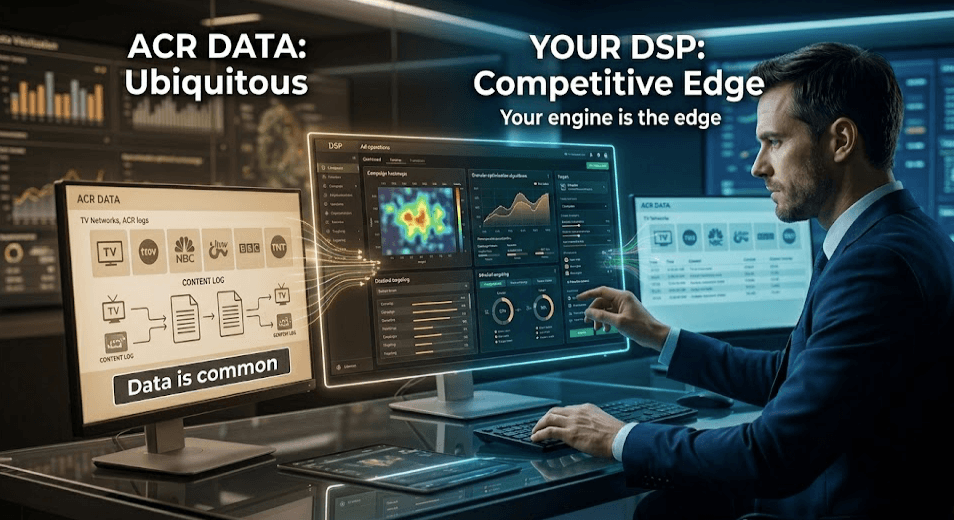
Most brands running connected TV right now are sitting on a goldmine of ACR data and doing almost nothing useful with it. The honest answer to “is ACR data worth investing in?” is: only if your DSP can actually activate it — and most can’t, or won’t, in any way that closes the loop on outcomes.
That gap isn’t a data problem. It’s a partnership problem.
What ACR Data Actually Promises (And Where It Breaks Down)
ACR — Automatic Content Recognition — tells you what someone watched, when they watched it, and on which device. For CPG and DTC brands, that’s enormously valuable signal. You could theoretically reach a household that just watched a competitor’s ad, or suppress impressions from people already saturated with your message, or sequence creative based on actual viewing behavior.
Theoretically.
The reality is that ACR data is only as powerful as the activation layer around it. If your DSP can’t ingest that signal in a way that actually influences bidding, frequency, sequencing, and measurement in real time — you just paid for a very expensive audience list that sits in a dashboard nobody checks.
Why Most DSP Evaluations Miss the Point
When brands evaluate DSP partnerships, they’re usually asking the wrong questions. “Do you have ACR data access?” is not the right question. The right question is: “What happens after the signal fires?”
Here’s what a real ACR activation capability should look like:
- Closed-loop measurement — Can the DSP connect a TV exposure to a downstream action (site visit, purchase, retail scan) at the household level?
- Real-time suppression — Can you stop serving impressions to someone who just converted, within hours not days?
- Competitive conquesting — Can you actually activate against competitor program viewership, not just claim you can?
- Cross-device identity resolution — Does the ACR signal follow the person from the living room to their phone without a 48-hour delay?
- Outcome optimization — Is the DSP bidding toward business outcomes or just delivery metrics?
If your DSP answers “yes” to all five but can’t show you a case study with a CPG or DTC brand proving it — that’s a no.
The Hidden Cost of “Good Enough” DSP Relationships
Here’s a take that doesn’t get said enough: a lot of brands are losing money not because their media plan is wrong, but because their DSP relationship is lazy.
Big holding company agencies bundle DSP access into opaque retainer structures where the incentive is scale, not performance. You get access to the technology. You rarely get someone who knows how to push it. The programmatic supply chain has a transparency problem that goes well beyond viewability — it extends into whether the tools you’re paying for are actually being used at all.
For CPG brands especially, where the margin is tight and attribution is hard, this matters enormously. A DSP that can connect ACR exposure data to retail sales lift — through a clean methodology, not a black box — is worth more than a DSP that simply offers access to premium inventory.
How to Evaluate a DSP Partnership on ACR Activation
Ask for proof, not promises
Request a measurement methodology document. If they can’t produce one, that tells you everything.
Push on latency
Signal latency kills performance. If there’s a 72-hour lag between a TV exposure and an actionable signal in the DSP, you’re not running connected TV advertising. You’re running delayed display.
Demand a unified view
Your ACR data, your first-party data, and your outcome data should live in one place — not three vendor portals you have to manually reconcile every Monday morning.
Test before you commit
Run a 60-day pilot with a defined outcome KPI. Not reach. Not impressions. A business result. If the DSP partnership can’t prove value in 60 days with ACR data, it won’t prove it in 12 months either.
At Junction 37, we run DSP evaluations for CPG and DTC brands as part of how we build media strategy — because the technology layer is just as important as the media plan itself. We don’t have preferred vendor relationships that cloud that judgment. We have client outcomes that depend on getting it right.
If you’re investing in CTV and not sure whether your ACR data is actually doing anything, that’s worth a conversation. Start with our media strategy audit — we’ll tell you exactly where the gaps are.
FAQ: ACR Data Activation and DSP Partnerships
What is ACR data in TV advertising?
ACR (Automatic Content Recognition) is technology embedded in smart TVs that identifies what content a viewer watches in real time. It creates a signal that advertisers can use for targeting, suppression, and measurement in connected TV campaigns.
Why does ACR data need to be inside a DSP to be valuable?
ACR data without activation is just information. A DSP with proper ACR integration can use that viewing signal to adjust bids, suppress redundant impressions, sequence messaging, and connect TV exposure to real business outcomes — all automatically and at scale.
How should CPG brands use ACR data differently than DTC brands?
CPG brands should prioritize retail sales lift measurement — connecting TV exposure to in-store or online purchase data. DTC brands can go further, using ACR signals for site visit attribution and customer acquisition cost optimization at the household level.
What’s the biggest mistake brands make when buying CTV programmatically?
Treating DSP access as a commodity. The platform matters less than how it’s configured and whether the team running it knows how to use ACR signals to optimize toward outcomes — not just to serve impressions efficiently.
Chris Pyne, Founder, Junction 37 – 30+ Years in Performance Media