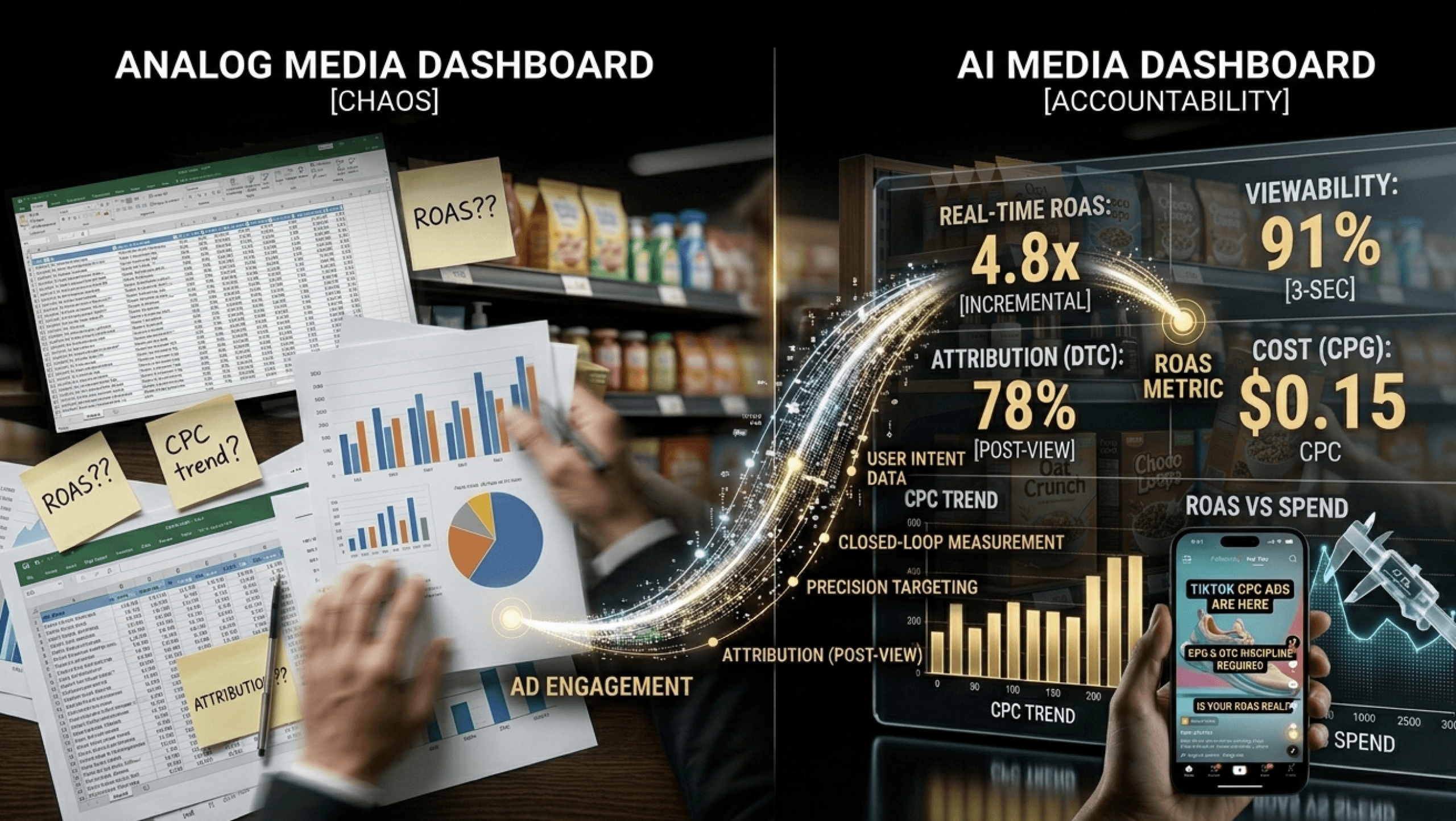
The real promise of AI-powered MMM isn’t speed. It’s the elimination of the excuse.
For years, brands accepted a dirty truth: by the time your media mix model finished running, the market had moved. Quarterly MMM outputs were handed down like stone tablets. They were expensive, slow, and treated as gospel even when they were already stale.
AI is collapsing that timeline. What used to take 8–12 weeks can now run in days. That’s not hype. That’s a structural shift in how fast brands can act on what their media spend is actually doing.
But even with that speed, mistakes can be made. Faster answers to the wrong questions is still a losing strategy.
Why AI-Powered MMM Changes the Game, And What It Doesn’t Fix
The compression of MMM timelines matters most when you have the operational discipline to act on the outputs. A $2 billion media budget like Hershey’s generates enough signal to make real-time reallocation meaningful. The model has something to work with.
For most CPG and DTC brands running $5M–$50M in media, the bottleneck was never the model. It was the meeting where someone overruled the data.
That’s not a technology problem. That’s a culture problem, and no amount of agentic AI fixes a CMO who defaults to gut feel when the numbers challenge their favorite channel.
The Three Scenarios Where AI-Powered MMM Actually Moves the Needle
Not every brand will see the same ROI from modernizing their measurement stack. Here’s an honest breakdown of when it genuinely changes outcomes:
- You’re running meaningful spend across 4+ channels. MMM requires enough cross-channel variation to isolate what’s driving what. If your budget is concentrated in one or two channels, you’re paying for complexity you don’t need.
- Your planning cycles are shorter than your model refresh rate. If you’re making quarterly budget decisions but your MMM outputs are six months old, you’re flying blind. AI-powered MMM closes that gap, but only if your team is set up to act on weekly or monthly signals rather than annual plans.
- You have clean, connected data. This is where most brands stall. Agentic AI is only as good as the inputs feeding it. Siloed data, inconsistent naming conventions, and disconnected platforms will produce fast, confident, wrong answers.
- You’re willing to reallocate, not just report. The brands that get the most out of modern MMM use it to make uncomfortable calls like cutting a beloved TV buy or doubling down on a channel that surprises them. If the model’s outputs get filed in a deck and forgotten, the investment was wasted.
What Performance Media Agencies Should Be Doing With This
At Junction 37, we work with CPG and DTC brands on performance media where measurement isn’t a quarterly ceremony. It’s an ongoing operating system.
The shift toward AI-powered MMM doesn’t change our fundamental belief that human judgment still sits at the center of good media strategy. What changes is the quality and speed of information that judgment is working with.
When we build media strategy for purpose-driven brands, we’re asking what decisions the data needs to support. That’s before we talk about what tools to buy. A sharper model doesn’t replace that thinking. It just makes acting on it faster.
The brands that win with AI-powered MMM won’t be the ones who bought the most sophisticated platform. They’ll be the ones who built the internal culture and external partnerships to actually use it.
The Bottom Line
AI is making MMM faster, more accessible, and harder to ignore. That’s genuinely good for the industry.
However, the measurement evolution only matters if the strategy behind it is sound. Speed without direction is just expensive noise, and right now, a lot of brands are about to buy faster ways to confirm their existing biases.
Don’t be one of them.
FAQ: AI-Powered MMM for CPG and DTC Brands
What is AI-powered MMM?
AI-powered Marketing Mix Modeling (MMM) uses machine learning and agentic AI to analyze how different media channels contribute to business outcomes, compressing what used to be a months-long process into days or weeks. It gives brands faster, more frequent reads on what their media spend is actually doing.
Is AI-powered MMM worth it for smaller CPG brands?
It depends on your media complexity and planning cadence. Brands running under $5M in media across one or two channels will likely get more value from rigorous multi-touch attribution and incrementality testing before investing in a full MMM overhaul. The tool should fit the scale.
How is AI-powered MMM different from traditional MMM?
Traditional MMM ran on static datasets and required weeks of analyst time to produce outputs. AI-powered MMM automates much of the modeling process, ingests data continuously, and can surface reallocation signals in near real-time. This makes it a live input to media decisions rather than a retrospective report.
What’s the biggest risk of adopting AI-powered MMM too early?
Bad data and organizational unreadiness. If your data infrastructure isn’t connected and clean, and your team isn’t structured to act on fast-moving insights, you’ll generate confident-sounding outputs that don’t reflect reality. The technology is ready. Most organizations aren’t yet.
Chris Pyne, Founder, Junction 37 – 30+ Years in Performance Media.