Brand Health Metrics Aren’t the Answer — But Ignoring Them Is Also Wrong
Here’s a direct answer to a question a lot of marketers are quietly asking right now: brand health metrics measure the long-term equity of your brand — things like awareness, consideration, purchase intent, and loyalty — as opposed to short-term conversion signals like ROAS or CPA. They matter. But treating them as an either/or choice with performance metrics is one of the most expensive mistakes a CPG or DTC brand can make.
The pendulum is swinging again. Returns are compressing. AI modeling tools are everywhere. And suddenly, brand health is fashionable again. Like it always gets when performance feels hard.
We’ve seen this cycle before. We’re not impressed by it.
Why the Brand vs. Performance Debate Is a False Choice
The brands winning right now aren’t choosing between brand health and performance. They’re measuring both — and they’re using smarter tools to connect the two.
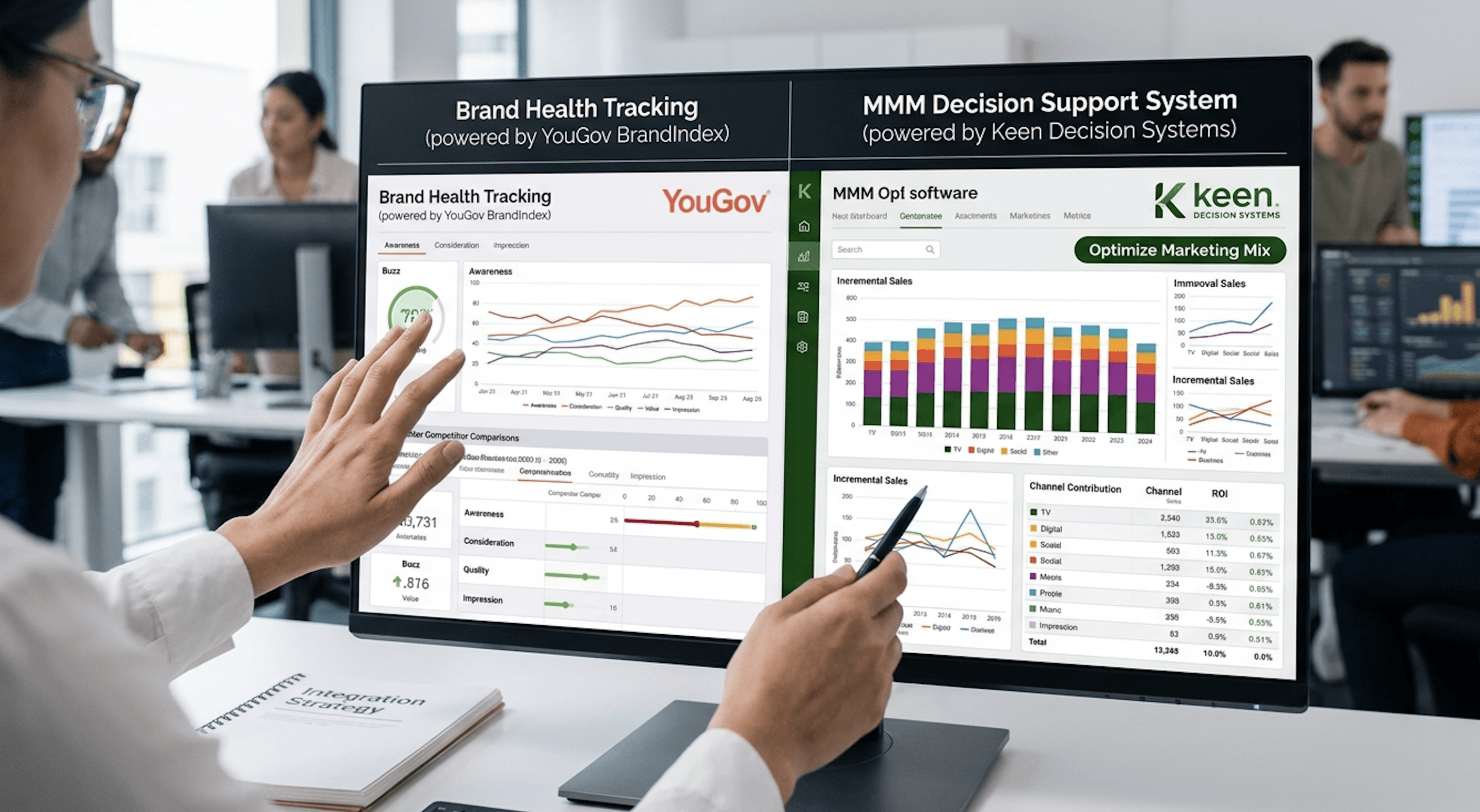
Marketing Mix Modeling (MMM) has been around for decades, but the new generation of AI-assisted MMM tools can finally do what the old ones couldn’t: show you how upper-funnel brand investment moves lower-funnel conversion metrics over time, with actual statistical confidence.
That’s the unlock. Not brand or performance. Brand investment *measured through* a performance lens.
The Real Problem Isn’t Measurement. It’s Impatience
Most CPG and DTC brands don’t have a brand health problem. They have a timeline problem.
Performance media delivers signals in days. Brand investment delivers signals in quarters. When a CFO asks what a brand awareness campaign “did,” the answer rarely fits in a weekly report and that mismatch creates pressure to cut brand spend before it’s had time to work.
MMM solves this by modeling contribution over longer windows. But only if your data infrastructure is clean enough to feed it something useful.
What Good Brand Health Measurement Actually Looks Like
If you’re going to invest in brand health metrics, here’s what we think actually deserves your attention:
- Unaided brand awareness — Are people thinking of you without being prompted? This is the metric that predicts long-term category share better than almost anything else.
- Brand consideration rate — Of the people who know you, how many would actually buy you? A brand can have high awareness and terrible consideration. That’s a positioning problem, not a media problem.
- Share of search — A scrappy, real-time proxy for brand health that correlates strongly with market share. Free to track. Underused.
- Purchase intent lift — Measured through brand lift studies tied to specific campaigns, this bridges brand exposure directly to bottom-funnel behavior.
- Net Promoter Score (NPS) trends — Not perfect, but if NPS is moving against you while paid performance looks fine, something is wrong upstream.
None of these replace conversion data. All of them make conversion data more interpretable.
How MMM and AI Modeling Tools Actually Bridge the Gap
Here’s what modern MMM gives you that last-click attribution never could: it tells you which brand-building activities created the conditions for a conversion that happened three weeks later.
When a DTC brand runs connected TV in Q3 and sees organic search volume spike in Q4, that’s not a coincidence — and it’s not something a pixel captures. MMM models it. AI-assisted platforms like Meridian (Google’s open-source MMM) or Robyn (Meta’s) are making this analysis accessible even for mid-market brands that couldn’t previously afford custom econometric modeling.
The caveat: garbage in, garbage out. These tools require at least two years of clean spend and revenue data to produce reliable outputs. If your measurement foundation is broken, AI modeling just automates the confusion.
This is exactly why our performance media practice always starts with a measurement audit before recommending channel mix or budget allocation.
The Agency Model Problem Nobody’s Talking About
There’s another reason brands are retreating to brand health metrics right now: performance has been poorly executed for years, and the results show it.
Holding company agencies staffed campaigns with junior buyers chasing short-term ROAS numbers because that’s what the quarterly review rewarded. When those numbers compress, as they always do when channels mature and competition increases, the instinct is to declare performance “broken” and pivot to something less measurable.
Brand health metrics, conveniently, are harder to hold someone accountable for.
We’re not saying brand investment is a hiding place. We’re saying it gets used as one. The solution isn’t to abandon performance discipline. It’s to demand better strategy and measurement that connects brand investment to business outcomes over a realistic time horizon.
FAQ: Brand Health Metrics and Performance Media</32>
What are brand health metrics?
Brand health metrics measure how consumers perceive and relate to your brand over time. Key indicators include unaided awareness, purchase consideration, share of search, and brand loyalty scores. They reflect long-term equity, not short-term conversion behavior.
Can brand health metrics and performance metrics be measured together?
Yes — and they should be. Marketing Mix Modeling (MMM) and AI-assisted attribution tools can quantify how brand investment contributes to downstream performance outcomes, bridging the gap between awareness and conversion data.
When should a CPG or DTC brand invest more in brand vs. performance media?
When your category awareness is low, your consideration rate is dropping despite strong conversion volume, or your paid media efficiency is declining despite optimized targeting — those are signals that brand investment needs to increase, not that performance should be abandoned.
Is MMM only for large brands with big budgets?
Not anymore. Open-source tools like Google’s Meridian and Meta’s Robyn have lowered the barrier significantly. You still need clean historical data and strategic interpretation — but the modeling itself is no longer cost-prohibitive for mid-market brands.
The bottom line: Brand health metrics are having a moment because performance got hard. That’s understandable. But the answer isn’t to run toward something less accountable. It’s to build measurement systems sophisticated enough to hold all of your marketing investment accountable.
Talk to Junction 37 about building a measurement framework that connects brand and performance
Chris Pyne, Founder, Junction 37 – 30+ Years in Performance Media.