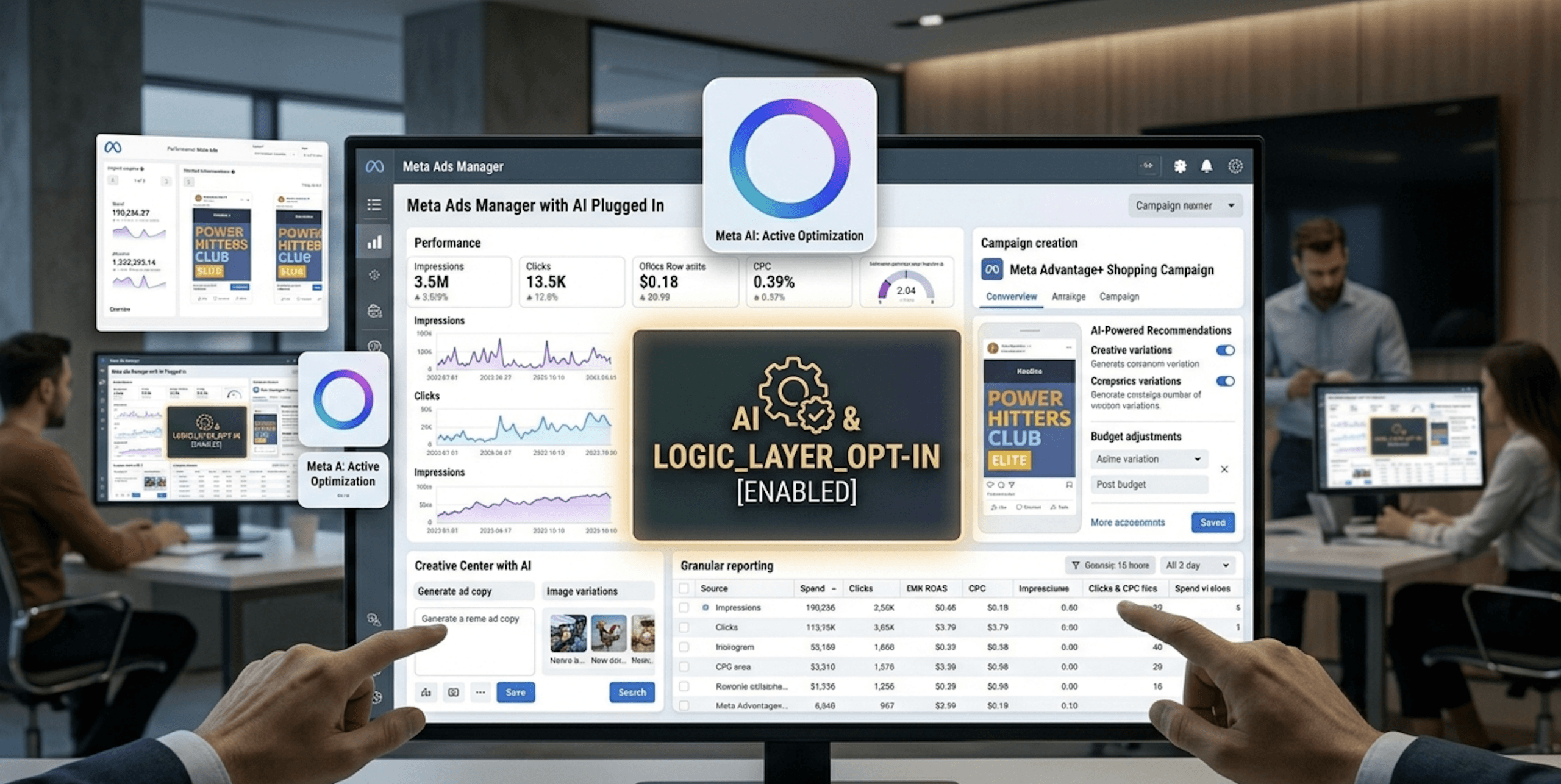
Meta AI connectors are changing who, or what, actually controls the decisions inside your ad campaigns. The short answer: if you’re a CPG or DTC brand not paying close attention, it might not be you anymore.
That’s not a reason to panic. But it is a reason to get clear-eyed about what you’re trading when third-party AI tools plug directly into your Meta ecosystem.
What Meta AI Connectors Actually Do (And Why That Matters)
Meta has opened its ad infrastructure to third-party AI tools, letting external platforms connect directly to campaign management, optimization, and bidding logic.
On the surface, this sounds like efficiency. And it can be. But what’s actually happening underneath is a transfer of decision-making authority away from your media team and into an algorithmic layer that Meta’s own systems don’t fully control either.
That’s a meaningful shift. Not inherently bad. But absolutely something you need to own consciously.
The Problem Isn’t AI. It’s Unaccountable AI.
We use AI tools at Junction 37. We believe in them. But we’ve seen what happens when brands, especially in CPG and DTC, let automation run without clear human oversight baked into the process.
Budgets drift. Creative fatigue goes unnoticed. Audience segments get over-targeted in ways that tank long-term brand equity while short-term ROAS looks fine. Everything looks green on the dashboard until it doesn’t.
The issue isn’t that AI is making decisions. The issue is when no human can clearly explain why those decisions were made and what they cost.
What You’re Gaining (Be Honest About This Too)
In fairness, Meta’s move to open its ecosystem creates real upside for brands that are ready for it.
Here’s where third-party AI connectors can genuinely help:
- Faster signal processing — AI tools can read auction-level data faster than any human and adjust bids in real time
- Cross-platform logic — connectors can sync campaign rules across Meta and other channels without manual reconciliation
- Testing at scale — automated creative testing across more variables than a team could manage manually
- Reduced operational drag — less time on tactical execution means more time on strategy (if your agency is using it that way)
These are real advantages. The brands that benefit most will be the ones who use these tools intentionally — not the ones who just turn them on and hope.
What You’re Giving Up (Be Even More Honest About This)
Here’s the part most vendors won’t tell you.
When a third-party AI layer sits between your brand and Meta’s ad system, you lose direct visibility into optimization logic. You’re trusting a black box built by a company whose incentives may not align with yours.
You’re also potentially loosening your grip on brand strategy decisions that used to require human judgment. Like which audiences you don’t target, which creative angles protect brand positioning, and where you’re willing to sacrifice efficiency for trust-building.
For purpose-driven brands especially, that’s not a rounding error. That’s the whole brand.
Three Questions to Ask Before Connecting Any AI Tool to Your Meta Account
1. Who owns the optimization logic? Can your agency explain exactly what rules the AI is using to make decisions — and change them if needed?
2. How is performance being defined? If the AI is optimizing for ROAS and your actual goal is LTV or new customer acquisition, you have a misalignment problem baked in from day one.
3. What’s the human check? Is there a real person, with real expertise, reviewing what the AI is doing weekly? Or is the AI just running?
If your current agency can’t answer all three clearly, that’s the problem. Not the AI.
The Bottom Line for CPG and DTC Brands
Meta’s AI connectors are infrastructure. Like any infrastructure, they’re neutral. What determines whether they work for you or against you is the expertise sitting on top of them.
The brands that win in this environment won’t be the ones with the most sophisticated AI stack. They’ll be the ones with human strategists who know what questions to ask, what signals to trust, and when to override the machine.
That’s not an argument against automation. It’s an argument for accountability.
FAQ: Meta AI Connectors and Campaign Control
What are Meta AI connectors?
Meta AI connectors are integrations that allow third-party AI platforms to connect directly to Meta’s ad ecosystem, enabling external tools to influence campaign management, bidding, and optimization decisions.
Are Meta AI connectors safe for DTC brands to use?
They can be. But, only when paired with clear human oversight, defined optimization goals, and an agency that understands how the AI logic maps to your specific business objectives. Turning them on without that context creates risk.
Do AI connectors replace media buyers?
No. They change what media buyers spend their time on. The best media teams use AI to eliminate low-value tasks so they can focus on strategy, creative judgment, and brand-level decisions that automation can’t make well.
How do I know if my agency is using AI tools responsibly on Meta?
Ask them to walk you through how campaign decisions get made. Specifically, who reviews automated optimizations, how often, and what criteria they use to override or adjust AI recommendations. If they can’t answer that, you don’t have a media partner. You have a dashboard vendor.
Ready to run Meta campaigns where humans are still driving?
Junction 37 builds performance media programs where AI does the heavy lifting and our team does the thinking. See how we approach performance media →
Chris Pyne, Founder, Junction 37 – 30+ Years in Performance Media.