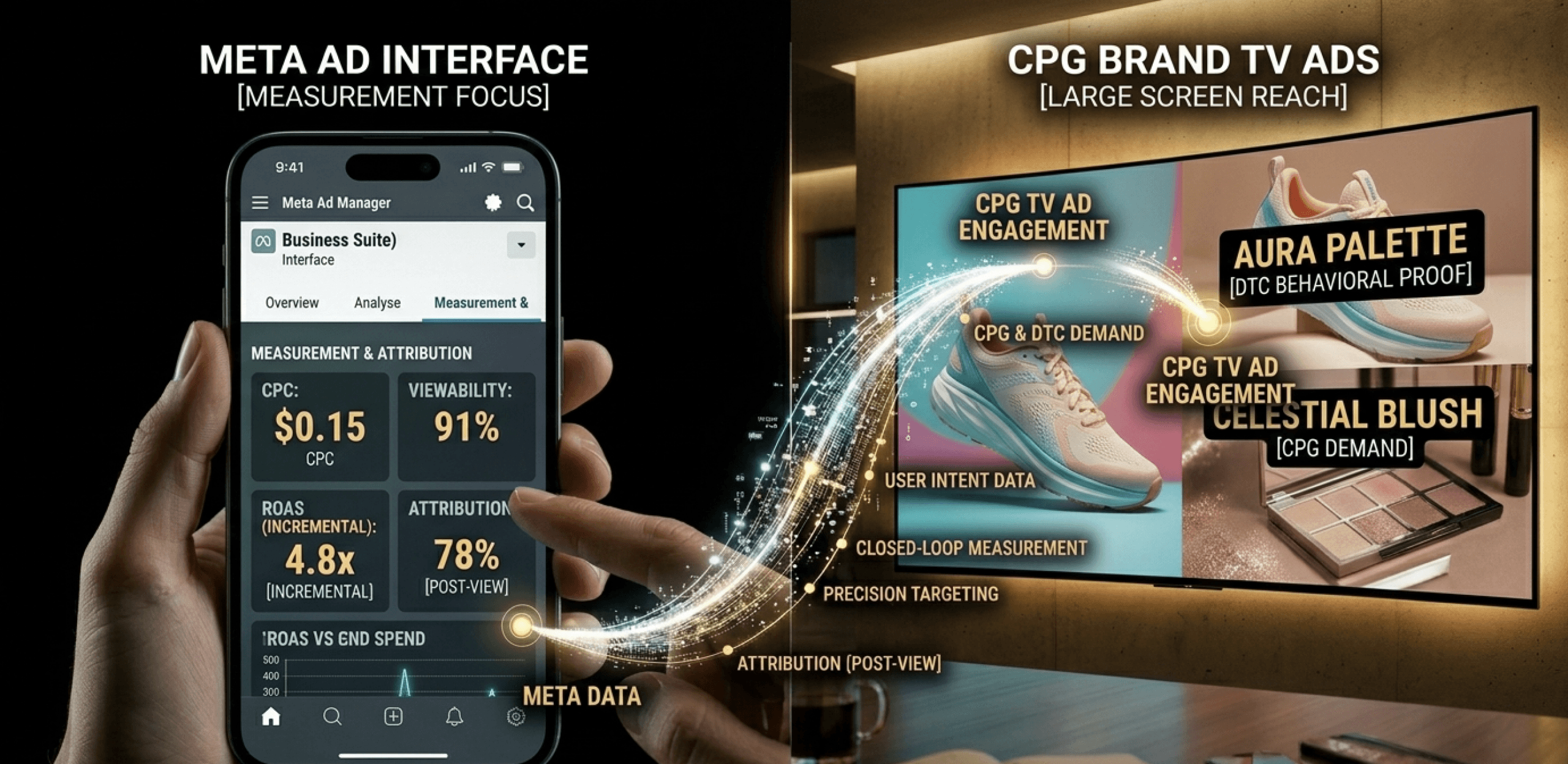
Meta CTV advertising is no longer a rumor. It’s a strategic direction. And for CPG and DTC brands running performance media, the implications are significant enough to start planning around right now, not after the beta invites go out.
Meta bringing its performance advertising infrastructure to connected TV could be the most meaningful shift in the CTV buying landscape since Amazon started selling ads on Prime Video. But whether it’s a game-changer or just a shiny new placement depends entirely on how you approach it.
Meta’s Real Superpower Isn’t Creative. It’s the Graph.
People talk about Meta’s ad product like it’s a creative platform. It’s not. It’s a data platform with creative delivery on top.
What makes Meta dangerous in the best way is its identity graph. First-party behavioral signals across Facebook, Instagram, WhatsApp, and Messenger give Meta a targeting foundation that most CTV players can’t match. Nielsen panels and ACR data are useful. A billion logged-in users is something else entirely.
If Meta can pipe that identity layer into CTV inventory, you’re suddenly looking at a living room screen that knows what someone searched for, what they bought, what they almost bought, and what their household income bracket looks like. That’s not TV advertising. That’s performance advertising on a TV.
Why This Matters More for CPG Than Anyone’s Saying
CTV has been fighting an identity problem since it took off. CTV ad spend surpassed $25 billion, but measurement fragmentation remains the industry’s biggest frustration. You get reach. You get impressions. You rarely get clean attribution.
Meta changes that math.
CPG brands in particular have struggled to connect upper-funnel TV investment to lower-funnel retail outcomes. Meta’s existing commerce integrations (Shops, Advantage+ catalog, pixel data) give it infrastructure that traditional CTV platforms don’t have. If Meta builds a bridge between CTV exposure and in-store or online conversion data, that’s the missing link CPG media teams have been asking for since 2020.
This is exactly what we evaluate when we’re building performance media plans for CPG brands. Where does awareness actually connect to a purchase signal, and how do you measure it without lying to yourself?
What to Be Skeptical About
Meta’s lower-funnel reputation is real, but it was built on a scroll environment. The living room is a different behavioral context. People watching TV are leaned back, not leaned in. The intent signals are softer. The purchase journey from couch to cart is longer.
Here’s what performance advertisers should pressure-test before scaling Meta CTV:
- Attribution windows: How will Meta count a conversion from a CTV exposure? Last-touch? View-through? The answer will dramatically affect how ROAS looks on paper.
- Creative requirements: 6-second and 15-second formats that crush it in-feed may not hold attention on a 65-inch screen without a real production investment.
- Audience overlap: If you’re already running Meta campaigns and adding CTV placements, frequency management across environments will be a real problem fast.
Measurement methodology: Incrementality testing will be non-negotiable. You need to know if the CTV exposure actually drove the outcome or just got credit for it.
How to Approach Meta CTV as a Performance Channel (Not Just a Reach Play)
Smart brands won’t treat this like traditional TV. They’ll treat it like a new Meta placement, which means testing with discipline, not hoping for reach.
Our recommendation for brands considering Meta CTV when it becomes widely available:
- Start with retargeting logic, not prospecting. Use CTV exposure for warm audiences who already know you. The intent gap is smaller.
- Build CTV-specific creative. Don’t repurpose your Stories ads. The format expectations are completely different.
- Set up a clean measurement before you spend. Define what success looks like, and make sure your attribution model doesn’t default to inflated view-through windows.
- Run incrementality tests from day one. This is too new to trust the native dashboard. You need a holdout group.
- Connect to your full-funnel media strategy, not just your Meta account. CTV touches the whole funnel. Plan for it that way.The brands that win with Meta CTV won’t be the ones who move fastest. They’ll be the ones who move smartest.
FAQ: Meta CTV Advertising for CPG and DTC Brands
What is Meta CTV advertising?
Meta CTV advertising refers to Meta’s expansion of its paid ad products (currently dominant on mobile and desktop) into connected television inventory. The goal is to bring Meta’s identity-based targeting and performance measurement capabilities to streaming environments on TV screens.
How is Meta CTV different from other CTV ad platforms?
Most CTV platforms target based on content context, IP addresses, or ACR (automatic content recognition) data. Meta’s differentiator is its first-party identity graph from billions of logged-in users, which could enable more precise audience targeting and closed-loop attribution than traditional CTV buying.
Is Meta CTV good for lower-funnel CPG advertising?
Potentially, but it depends on execution. Meta’s strength is connecting behavioral signals to purchase intent. If that infrastructure extends to CTV, CPG brands could finally link TV exposure to actual conversion data. However, the passive viewing environment of TV requires different creative and measurement thinking than mobile.
What should brands do to prepare for Meta CTV?
Start by auditing your current Meta measurement setup, building CTV-ready creative assets, and defining incrementality testing protocols. Don’t wait for the product to launch to start planning. The brands with the right infrastructure in place will move faster and waste less budget.
Ready to build a performance media plan that accounts for what’s coming, not just what’s available today?
Talk to the Junction 37 team about your media strategy.
Chris Pyne, Founder, Junction 37 – 30+ Years in Performance Media.