Key Takeaways
- Most CPG brands are still measuring a linear funnel that hasn’t existed for at least three years.
- Discovery and purchase now happen in the same moment on social and agentic platforms, making last-click attribution actively misleading.
- Off-site media spend (social, CTV, programmatic) drives on-site conversion, but most measurement setups can’t connect the two.
- Brands that unify measurement across channels make faster budget decisions and waste less on channels that look productive but aren’t.
- Unified measurement is a media strategy prerequisite that determines which channels get funded.
- Without clean cross-channel attribution, CPG brands are optimizing for signals, not outcomes.
—
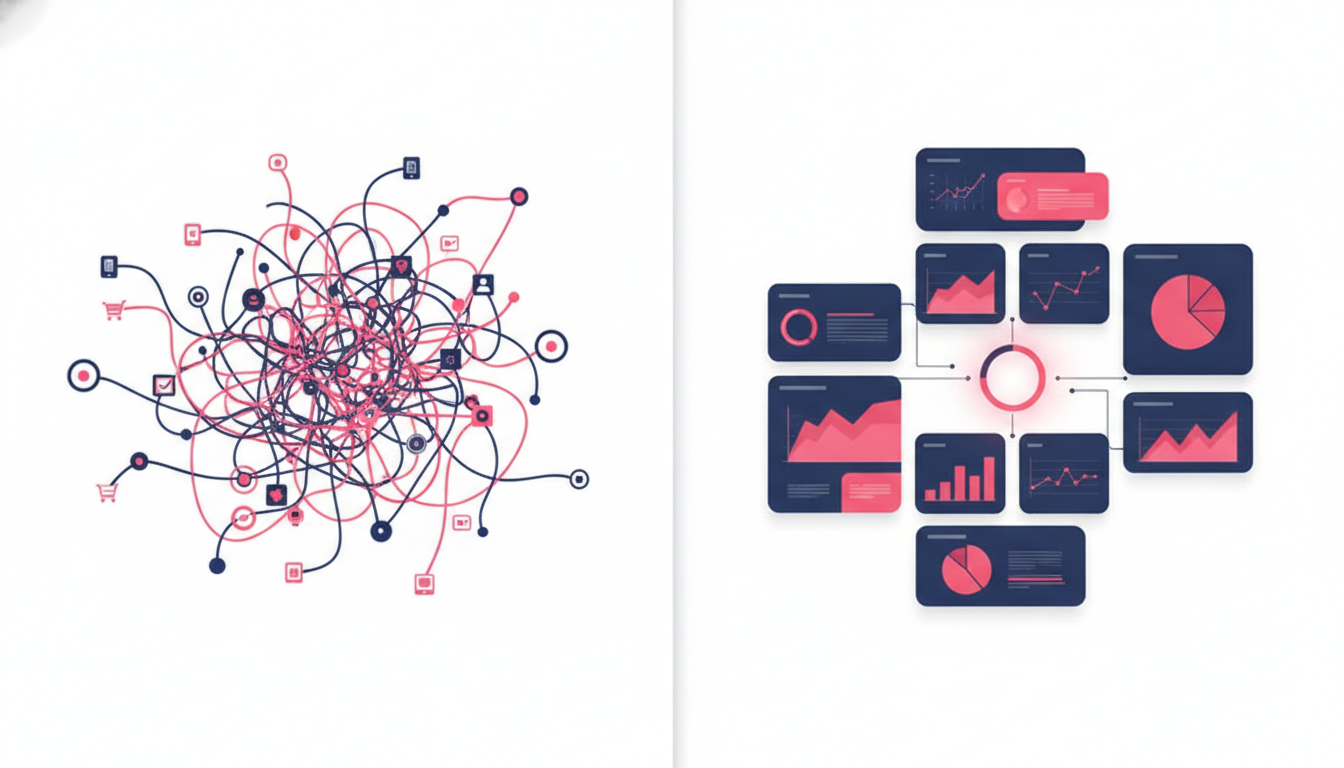
The commerce funnel has already evolved. Unified measurement is the practice of connecting every paid media touchpoint, across social, retail media networks, CTV, and programmatic, to a single view of what actually drove a purchase. For CPG brands spending across a fragmented landscape, it’s the difference between knowing what works and guessing.
The Funnel You’re Measuring Doesn’t Exist Anymore
Brands built their measurement frameworks around a world where awareness lived at the top and conversion happened at the bottom. Consumers moved in one direction. You could assign channels to stages and call it a strategy.
That model is gone. A shopper can discover a product in a TikTok video, add it to a cart without leaving the app, and complete the purchase in under 90 seconds. Another shopper might see a CTV ad on Tuesday, search on Amazon on Thursday, and buy in a physical store on Saturday. Neither of those journeys shows up cleanly in a platform-reported ROAS number.
Why Last-Click Attribution Is Lying to You
Platform-reported attribution was never neutral. Every walled garden, Meta, Amazon, Instacart, gives itself credit for conversions it may have only partially influenced. Last-click models then amplify that distortion by erasing every touchpoint that came before the final one.
For CPG brands, this creates a specific and expensive failure mode. Off-site channels like social video, CTV, and programmatic display build the awareness and intent that drives retail conversion. But because those channels rarely capture the final click, they look underperforming in most dashboards.
So brands cut them. Retail media spend goes up. Quietly, total sales flatten because the pipeline that fed retail intent has dried up.
What Unified Measurement Actually Requires
This isn’t a technology problem you solve by buying a new platform. It’s a data architecture and strategic alignment problem. Here is what it actually takes:
- A single source of truth for conversions. Pick one. Whether it’s your retail partner’s sales data, a third-party measurement vendor, or your own first-party signal, every channel needs to be evaluated against the same denominator.
- Agreed-upon attribution windows by channel type. CTV and upper-funnel social need longer windows (seven to fourteen days at minimum). Sponsored search at retail operates on a shorter cycle. Treating them the same distorts both.
- Incrementality testing built into the budget, not bolted on after. Holdout tests and geo-based lift studies are the only way to know whether a channel is driving purchases or just showing up near them.
- Cross-retailer sales visibility. If you’re spending media that influences both Amazon and Target, but you can only see one retailer’s data, you’re missing half the answer. Retail data aggregation is unglamorous infrastructure work, but it’s non-negotiable.
- A shared framework between media and commerce teams. The biggest measurement gaps we see are organizational, not technical. Media buyers optimizing for CTR and commerce teams tracking velocity rarely speak the same language. Unified measurement only works when both sides agree on what success looks like before the campaign launches.
Our retail media strategy work for CPG brands goes deeper on how to structure that alignment before a dollar gets spent.
The Off-Site to On-Site Connection Is Where Most Brands Fall Apart
Social and programmatic spend is supposed to pull consumers toward retail, but you need mechanisms that actually trace that path.
Pixel-based tracking is weaker than it was three years ago. Privacy changes have degraded signal fidelity across the board. This makes modeled measurement, specifically media mix modeling combined with platform lift studies, more important, not less.
The brands getting this right are layering methods. MMM tells them directional channel contribution over time and incrementality tests validate specific hypotheses. Platform data provides the granular creative and audience signals. Each source fills in what the others miss.
If you want to understand how agentic commerce is adding another layer to this challenge, our piece on what CPG brands must do now in agentic commerce is worth reading alongside this one.
The Real Cost of Not Fixing This
Fragmented measurement not only creates confusion, it creates systematic misallocation. Brands consistently overfund the channels that claim credit and underfund the channels that create demand. Over a 12-month budget cycle, that gap compounds.
We have worked with CPG brands where reallocating 15 to 20 percent of retail media spend back into off-site channels, once measurement validated the connection, produced meaningful total sales lift without increasing the overall budget. The media was not the problem; the measurement was.
Unified measurement is how you earn the right to make confident budget decisions in a commerce environment where nothing moves in a straight line anymore.
—
Frequently Asked Questions
What Is Unified Measurement in Retail Media?
Unified measurement is a framework that connects paid media activity across all channels, including social, CTV, programmatic, and retail media networks, to a single, consistent view of what drove a sale. It replaces siloed, platform-reported metrics with a cross-channel picture of actual business outcomes.
Why Does Unified Measurement Matter More for CPG Brands Than Other Categories?
CPG purchases rarely happen in one session or on one platform. A consumer might encounter a brand through social video, search for it on a retail app, and buy it in a physical store. CPG brands spending across multiple retailers and channels can’t optimize effectively without a measurement system that accounts for that entire path.
What Is the Difference Between Last-Click Attribution and Incrementality Testing?
Last-click attribution gives full credit for a conversion to the final touchpoint before purchase, whereas incrementality testing measures whether a channel actually caused additional purchases that would not have happened without it.
How Should CPG Brands Start Building a Unified Measurement Framework?
Start with three things: align on one conversion source of truth across your media and commerce teams, define attribution windows by channel type rather than using a single default, and run at least one geo-based or holdout incrementality test per quarter on your highest-spend channel. That foundation is more valuable than any measurement platform you could buy.
—
Ready to connect your media spend to real commerce outcomes? The team at Junction 37 builds performance media strategies grounded in measurement that actually reflects how consumers buy. See how we work or get in touch to start the conversation.
—
Chris Pyne, Founder and CEO of Junction 37 and its sister venture Series A. He built Cortex, J37’s proprietary AI-driven planning ecosystem, and pioneered the integration of predictive marketing science into client strategy. Previously, Chris held C-suite roles at OMD USA and MediaCom, where he led planning for $7B in billings and 700+ employees.